
Summary: Hospitals must adopt continuous Medicaid eligibility verification and redetermination processes to adapt to upcoming changes in 2027, where eligibility will be reassessed every six months for certain adults. This involves proactive eligibility checks, capturing redetermination dates, and ensuring clear ownership of eligibility issues to prevent denied claims and maintain financial stability.
A 27-day inpatient stay clears initial 270/271 eligibility on day one, but the state disenrolled the patient on day 15 following an unanswered renewal form. The business office submits an eight-figure claim on day 30, only to receive a CARC 177 denial indicating patient eligibility could not be verified for the final two weeks of care.
Running a resilient Medicaid eligibility verification and redetermination process for hospitals means treating payer status as a shifting balance rather than a static registration record. Between rolling post-pandemic state renewals and shifting federal timelines, coverage drop-offs occur mid-treatment, turning valid hospital encounters into uncollectible bad debt.
Why Medicaid Eligibility Matters More Than Ever
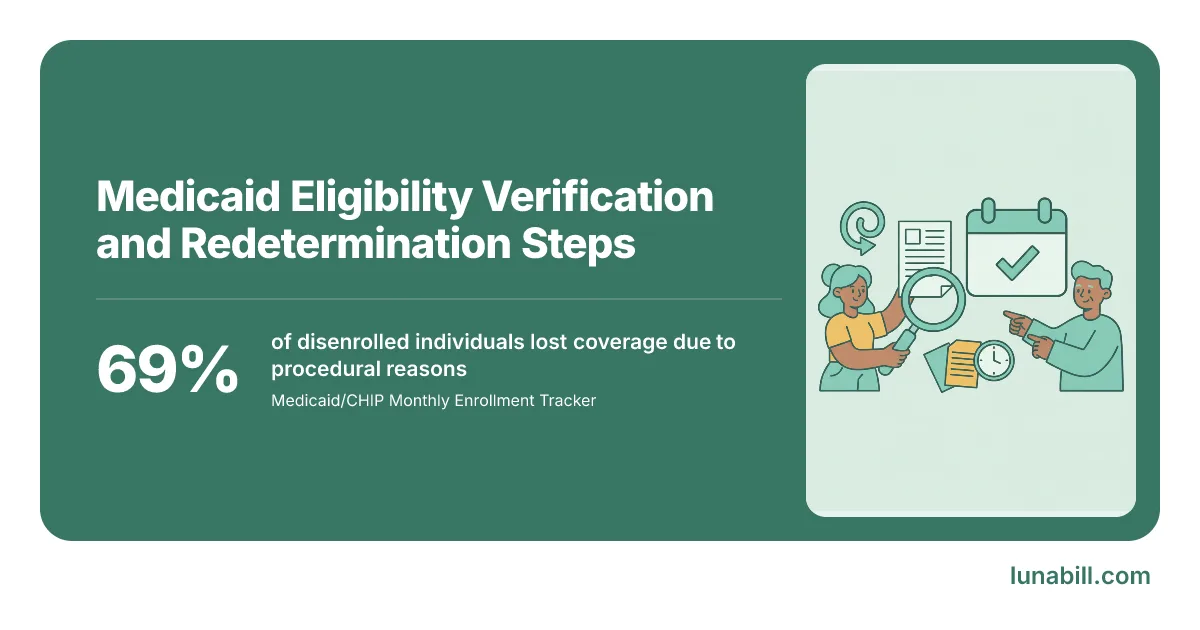
State eligibility decisions now shift month to month rather than year to year. The Kaiser Family Foundation's Medicaid Enrollment Tracker found that 69% of individuals disenrolled during recent continuous enrollment unwindings lost their Medicaid coverage due to procedural reasons rather than verified changes in income. Beneficiaries missed renewal packets mailed to outdated physical addresses, failed to return employment records within strict 30-day windows, or hit regional processing backlogs.
Federal oversight documented parallel problems across state agencies. A review by the Government Accountability Office in GAO-24-106883 noted that federal reviews between 2014 and 2021 cited 32 states for missing data or insufficient documentation in their eligibility determination files. Further analysis in GAO-25-107413 established that disenrollments post-COVID varied widely across populations and regions, leaving providers exposed to sudden shifts in patient coverage profiles.
Operating assumptions that treat patient status as stable for twelve months guarantee unbilled backlog. When procedural drops hit expansion adult populations, retroactive reinstatement often takes months of manual casework, freezing facility cash flow.
Start With the Most Basic Question: Is the Patient Eligible?
The intake desk cannot rely on a generic self-pay designation when an uninsured patient enters registration. Staff must immediately screen the encounter against state-specific MAGI thresholds, age criteria, disability status, and presumptive eligibility categories.
Hospitals need dedicated on-site financial counselors who take ownership of the patient account before bed placement or clinical discharge. If an individual qualifies for presumptive Medicaid, staff must submit temporary paperwork through the state portal immediately to establish a binding coverage date, preventing self-pay write-offs.
A clear split in responsibility protects the workflow:
- Registration verifies photo ID, demographic data, and current household income.
- Financial counselors cross-reference regional Medicaid portals for past enrollment history or open application numbers.
- Case managers receive notification if the patient presents with chronic clinical needs requiring high-cost pharmaceuticals or post-acute facility authorization.
Eligibility Should Not Be a One-Time Admission Check
Long-stay patients represent severe denial risk when teams only run eligibility batch queries at initial admission. Coverage often lapses silently midway through an extended intensive care stay or prolonged rehabilitation admission due to monthly income variations or missed state paperwork.
Revenue cycle leaders should mandate automated 270 transaction queries every 30 days for every in-house patient, with weekly batch checks for complex ICU cases. If the 271 response returns an inactive status, a changed Managed Care Organization (MCO) plan ID, or an unexpected primary commercial payer, the patient accounting system must alert financial clearance immediately.
The automated query rule stops holding true for short-stay outpatient surgery and same-day procedural visits. Running automated 30-day reverifications on same-day imaging or outpatient lab visits wastes system transactions and creates unneeded worklist volume, since the entire encounter resolves well within the original verification window.
Capture the Redetermination Date Before It Becomes a Problem
State Medicaid agencies manage rolling renewal dates, yet hospital clearinghouse reports frequently discard or bury the exact benefit termination date. Patient access teams must extract the redetermination deadline directly from the 271 transaction or the state fiscal agent portal and record it in a dedicated electronic health record field.
Establishing a proactive review period gives staff time to prevent sudden lapses:
- 30 days before the renewal date: Screen the patient chart for planned admissions or upcoming specialist visits.
- 20 days before: Reach out to the patient via phone, text message, or patient portal to confirm receipt of state redetermination packets.
- 10 days before: Assist the patient in uploading proof of wages or residency documents to the state portal to avoid administrative disenrollment.
Catching these windows early avoids the labor-intensive casework required to request 90-day retroactive reinstatements after a coverage lapse.
A Change in Coverage Should Create Immediate Work
When an EDI 271 transaction flags a coverage drop or plan termination, the encounter must immediately land in a high-priority work queue. Waiting until post-discharge coding to identify lost coverage practically guarantees a timely filing violation or a complete write-off.
The assigned eligibility specialist must review the record by the next business day while clinical teams still have daily physical access to the patient or family. If the patient transitioned to an out-of-network Medicaid MCO plan, patient access can seek a single-case agreement, initiate emergency prior authorization, or file transfer paperwork.
Three Attempts Should Lead to Escalation, Not a Parking Place
Unworked accounts frequently sit idle in queue folders under indefinite "pending info" tags. Revenue cycle managers need strict outreach thresholds to prevent hidden aging:
- First contact attempt: Place a direct phone call within 24 hours of coverage loss and send a structured SMS reminder through the patient engagement system.
- Second contact attempt: Attempt contact at an alternate time of day on day three, and mail an eligibility information request form to the home address.
- Third contact attempt: Make a final direct call on day five, coupled with an in-person bedside visit if the patient remains admitted.
If three documented contacts fail to secure the required documentation, route the balance to an "Eligibility Unresolved" status. This status should immediately trigger an escalation review with the patient access manager and case management director, who can decide whether to tap charity care policies, coordinate external field investigators, or route the claim to secondary self-pay collections.
Ownership Should Stay With the Team Best Positioned to Resolve the Issue
Too many health systems pass coverage denials back and forth between Patient Access and Central Billing. When a claim kicks back with CARC 27 (expenses incurred after coverage terminated), billing teams should not spend weeks calling payers to confirm termination dates that intake staff could have identified.
The front-end financial counseling team must retain sole ownership of coverage verification issues until the patient account presents a verified payer ID, valid subscriber number, and active eligibility dates:
| Responsibility Parameter | Financial Clearance / Intake | Central Business Office / Billing |
|---|---|---|
| Account Status | Preadmit through final clinical discharge | Post-discharge unbilled through payment receipt |
| Primary Task | Verify Medicaid status, enroll uninsured, track renewals | Submit clean 837 claims, manage clearinghouse edits |
| Coverage Discrepancies | Contact patients, request retroactive coverage, fix MCO plans | Flag CARC 27/177 denials back to financial clearance |
| Documentation Target | State enrollment proof and eligibility determination letters | 835 remittance posting and ERA reconciliation |
Clear separation keeps billers focused on clearinghouse rejections and payer follow-up rather than basic patient intake casework.
The 2027 Changes Make Visibility More Important
Upcoming federal administrative guidelines and updated state reporting policies outline continuous adjustments to adult expansion criteria. Policy updates like the CMS State Health Official Letter SMD #26-001 emphasize evolving requirements for health programs, pushing states toward stricter tracking schedules.
Future frameworks under federal consideration propose shortening adult expansion review cycles to six-month intervals, alongside community activity and reporting stipulations. Frequent status changes mean a hospital treating a patient over a multi-month period can no longer assume that coverage verified in January remains active by June.
Meeting these shifting demands requires tight data integration across state Medicaid interfaces, real-time EDI batch processing, and intelligent clearinghouse routing to catch plan reassignments before claims leave the door.
What I Would Validate Before 2027
Hospital revenue cycle executives should review their operational infrastructure across these critical operational controls:
- Establish a single managerial owner responsible for self-pay conversion and Medicaid eligibility verification.
- Configure automatic 30-day periodic eligibility reverifications for all inpatient admissions exceeding two weeks.
- Build work queues that automatically isolate accounts when 271 transactions display an active-to-inactive benefit change.
- Configure discrete fields in the EHR to house state redetermination deadlines across all registered Medicaid patients.
- Trigger automatic worklist tasks 30 days prior to a patient's documented redetermination date.
- Enforce next-business-day follow-up standards for any mid-stay disenrollment detected on admitted patients.
- Require formal supervisory escalation after three failed attempts to reach an unverified patient.
- Formalize an "Eligibility Unresolved" queue to prevent accounts from stalling in general patient access folders.
- Document clear handoff rules so billing staff never work frontline eligibility errors without intake involvement.
How LunaBill Can Support Your Revenue Cycle
When eligibility lapses escape front-end controls, back-end teams absorb the resulting claim denials and payment delays. LunaBill deploys a coordinated team of 13 specialized AI agents ("Luna") that works the AR queue end to end. The platform verifies payer portals like Availity and Waystar for claim status, eligibility records, and remittance details. It navigates complex Interactive Voice Response phone trees, remains on hold, and secures resolution details directly from live payer representatives.
When claims fail due to coverage discrepancies, Luna reads the denial codes, drafts appeals, corrects payer ID and coordination of benefits errors, and resubmits claims through the hospital's existing clearinghouse. The system writes payment records, reference numbers, and detailed call logs back to Epic, Cerner, and GoRev under a full audit trail, leaving complex human escalations to internal billers.
The service operates on a performance-based structure with no upfront fees, software licenses, or setup costs, billing only a share of net collections after recovered funds deposit. At Nutex Health, a 24-campus health system using Epic and GoRev, LunaBill worked more than $32 million of AR in 30 days with zero added headcount, dropping commercial days in AR aged 60+ days from 45 to 7 within three months of go-live, as detailed in the Nutex Health revenue cycle case study.
Conclusion
Audit your active inpatient accounts against your state's Medicaid portal tomorrow morning to pinpoint every patient whose coverage expired mid-stay. Measure the dollar volume of your CARC 27 and CARC 177 denials over the trailing 90 days to determine your organization's true exposure to administrative disenrollments.
Address these gaps by writing explicit queue rules into your patient access system. Mandate automatic 30-day reverifications on long-stay cases and build a dedicated field for benefit redetermination dates. Getting these operational safeguards in place requires clean coordination between intake supervisors and patient access analysts before changing regulatory rules increase the volume of unverified claims.
Frequently Asked Questions
What should a hospital do when an in-house patient is disenrolled mid-stay?
Contact the patient or family within 24 hours to secure missing documentation, then submit an emergency redetermination request to the local Medicaid office. Most state agencies provide a 90-day grace period where submitting the required renewal forms can restore Medicaid coverage retroactively back to the start of the month, protecting the open inpatient stay.
How often should hospital patient access re-verify Medicaid coverage?
Run batch EDI 270 transactions at admission, every 30 days for continuous inpatient stays, and on the date of discharge. For high-cost pharmacy or specialty outpatient services spanning multiple calendar months, reverify eligibility on the first day of each calendar month, when state enrollment files most frequently disenroll members for procedural non-compliance.
Which CARC codes signal that Medicaid redetermination failed?
CARC 27 indicates expenses were incurred after coverage terminated, while CARC 177 indicates patient eligibility could not be verified. When remittances show CARC 27 alongside RARC N30 (patient ineligible for this period), the account requires immediate front-end counseling intervention to check for retroactive state reinstatement or an unrecorded commercial primary payer.
Sources
- Case study
- LunaBill
- GAO — "Medicaid and Children's Health Insurance: Disenrollments After COVID-19 Varied Across States and Populations" (gao-25-107413)
- GAO — "Medicaid: Federal Oversight of State Eligibility…" (GAO-24-106883)
- KFF — Medicaid/CHIP Monthly Enrollment Tracker
- Medicaid.gov / CMS — State Health Official Letter SMD #26-001